Built for procurement and vendor negotiations

Features that turn preparation into repeatable wins

Negotiations.AI helps teams capture a clear strategy (BATNA, ZOPA, anchors), practice with realistic simulations, and build institutional memory that improves every future negotiation.

Strategy canvas

BATNA, ZOPA, anchors, concessions

Simulations

Realistic role‑play with coaching

Governance

Approvals, templates, consistency

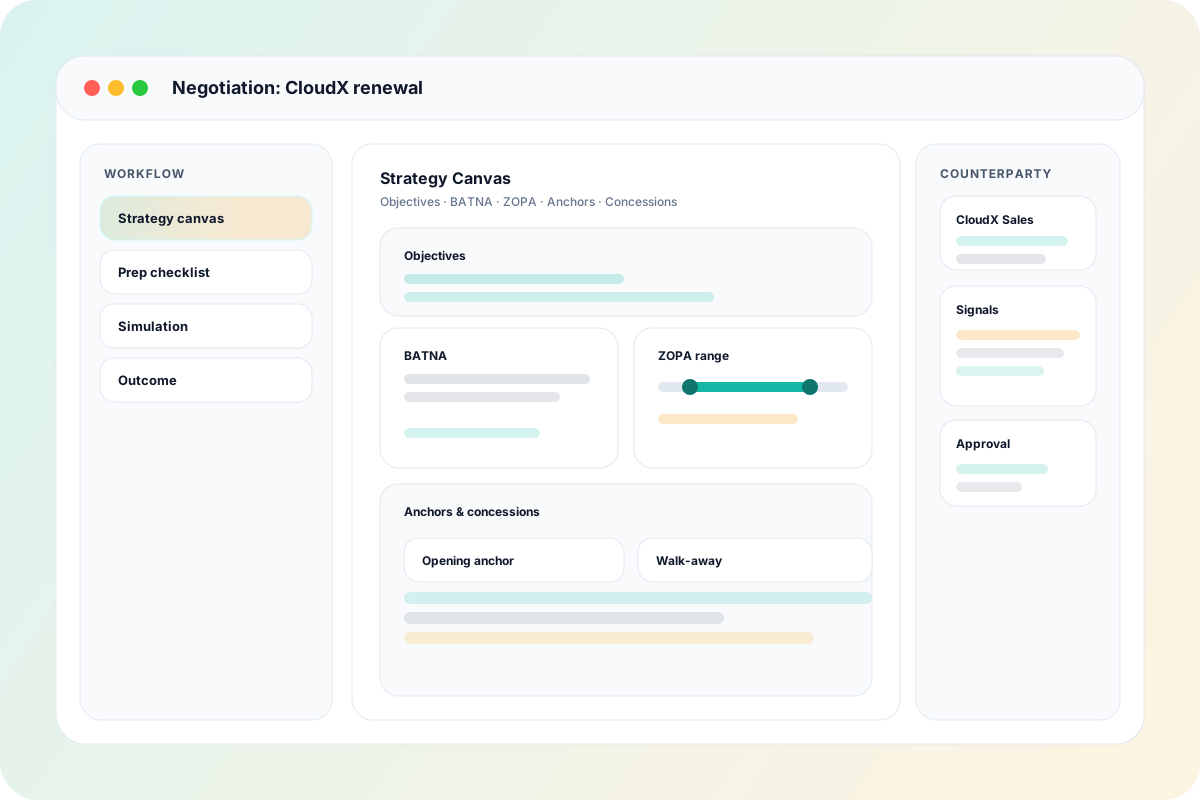
Strategy canvas preview showing objectives, BATNA, ZOPA and concession planning

Preview of the Strategy Canvas: plan your position, trade-offs, and talk tracks.

A clear workflow from start to outcome

Use the same 4-step flow for renewals, supplier price increases, payment terms, SLAs, and strategic sourcing.

Step 1
Initiate

Capture context in minutes (or upload supporting docs)

Start with a short prompt, then attach the artifacts your team already has. Negotiations.AI helps you consolidate the facts, stakeholders, constraints, and success criteria into a usable starting point.

  • Contracts & agreements (terms, pricing, SLAs)
  • Pricing proposals and competitor quotes
  • Email threads and discussion history
  • Meeting notes and past negotiation context
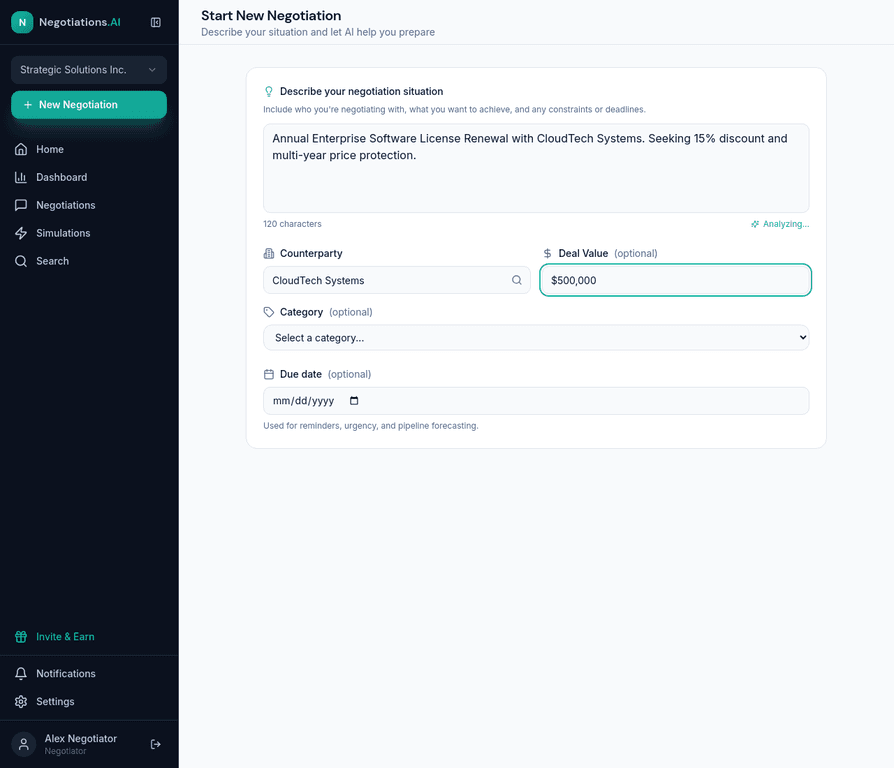
New negotiation form capturing the situation, counterparty, deal value, and due date

Example intake: start with a short prompt, then add counterparties, deal value, and attachments.

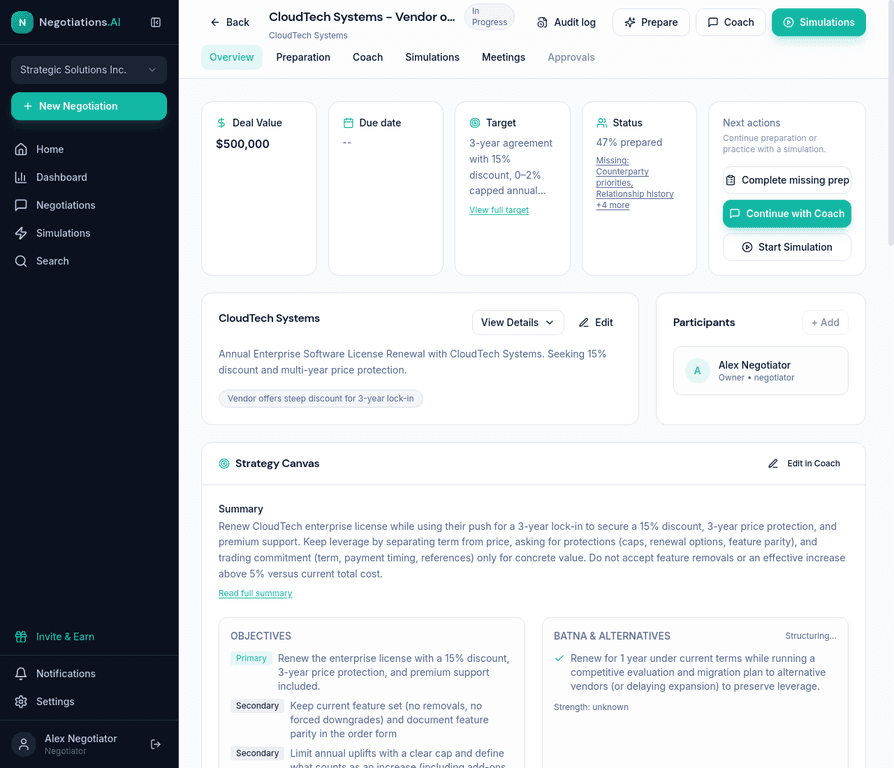
Strategy canvas showing objectives, BATNA alternatives, and negotiation summary

Strategy Canvas: align the team on objectives, constraints, and BATNA alternatives.

Step 2
Strategize

Build a negotiation plan with BATNA, ZOPA, and anchors

Turn messy inputs into a clear, shareable plan. Capture your opening position, walkaway, concession trades, counterparty hypotheses, and talk tracks you can reuse across the organization.

BATNA + ZOPA

Know your range and walkaway.

Talk tracks

Scripts, questions, and rebuttals.

Stakeholders

Who approves what, and why.

Consistency

Reusable templates and standards.

Related reading: negotiation strategy checklist.

Step 3
Practice

Role‑play with an AI negotiation coach

Rehearse the real conversation with an AI counterparty. Get feedback, refine your phrasing, and pressure‑test your plan before you negotiate live.

  • Scenario-based practice (renewals, price increases, SLAs, payment terms)
  • Live scorecards for questioning, concessions, and value creation
  • Coach prompts when you get stuck (or want to escalate)
  • Save what worked for next time

Related reading: how to use an AI negotiation coach.

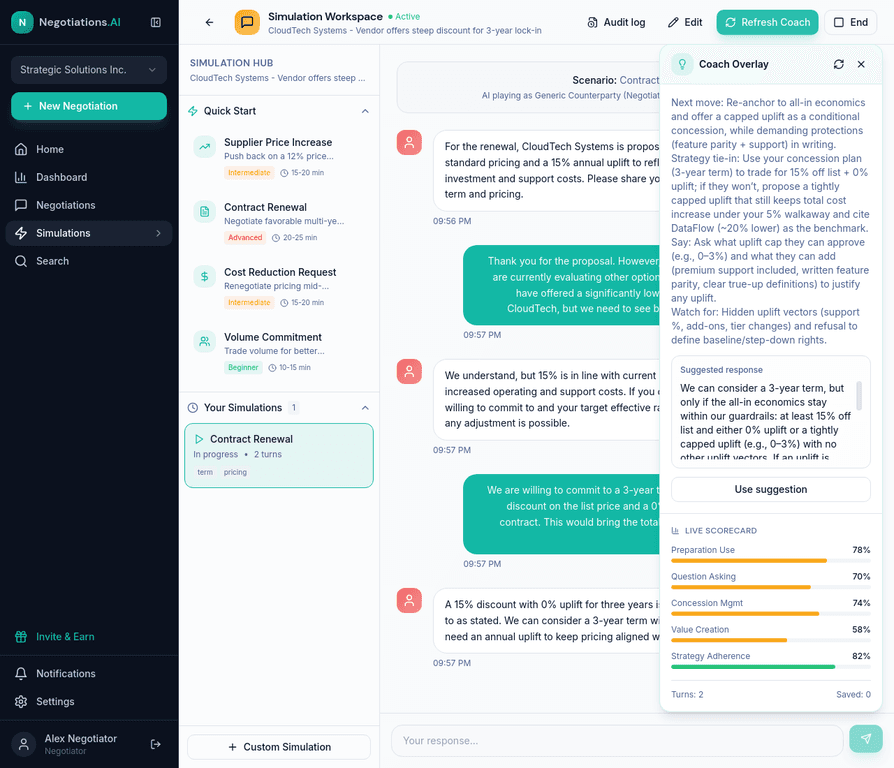
Negotiation simulation workspace with AI coach overlay and live scorecard

Example simulation with live coaching scorecard.

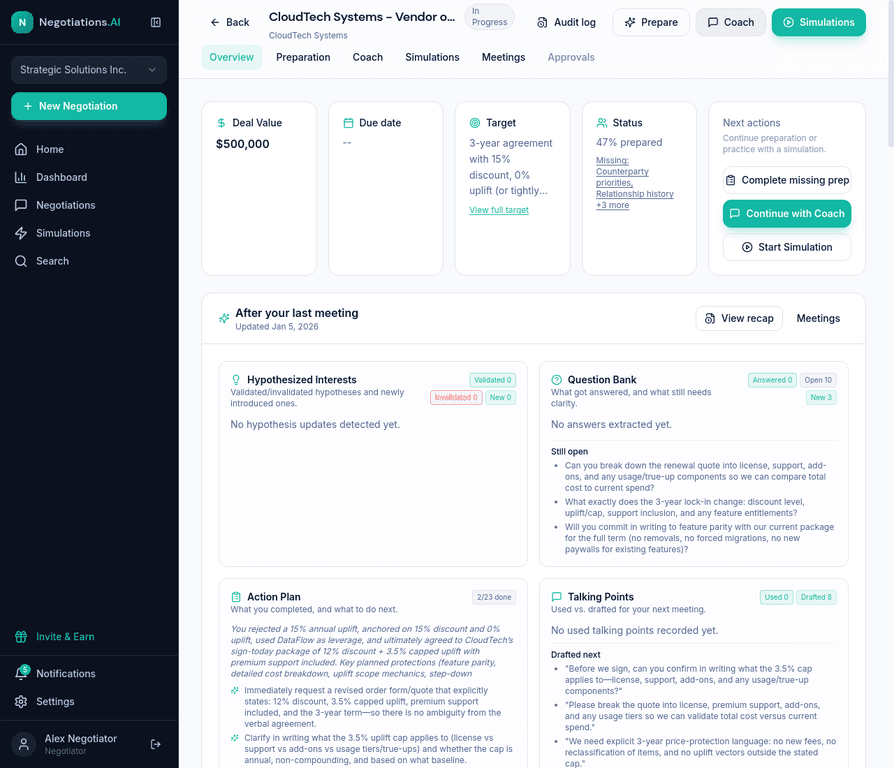
Negotiation workspace after a meeting with action plan, question bank, and talking points

After meeting: review action plans, question banks, and draft talking points for the next round.

Step 4
Execute

Capture outcomes and build institutional memory

After each negotiation, log what happened, what worked, and what you’d change. Over time, your team builds a living playbook: templates, learnings, and reusable strategy patterns.

Templates & playbooks

Reusable prep and conversation structures.

Approvals & governance

Standardize how decisions get signed off.

Counterparty memory

Track counterparties and relationship context.

Reporting

See readiness, pipeline value, and outcomes.

Related reading: procurement negotiation playbook.

Built for teams, not just individuals

Negotiations.AI supports three key roles—Category/Deal Owners, Executive Approvers, and CoE Leads—so the whole team stays aligned from strategy to signature.

Category manager / deal owner

Draft the strategy, rehearse the conversation, and walk into the negotiation with confidence.

Executive approver

Review a concise strategy canvas, understand trade-offs, and approve with context.

CoE lead

Standardize templates, capture learnings, and improve negotiation capability across the org.

Ready to prepare your next negotiation?

Try it free or browse the blog for negotiation strategy, procurement playbooks, and game theory.